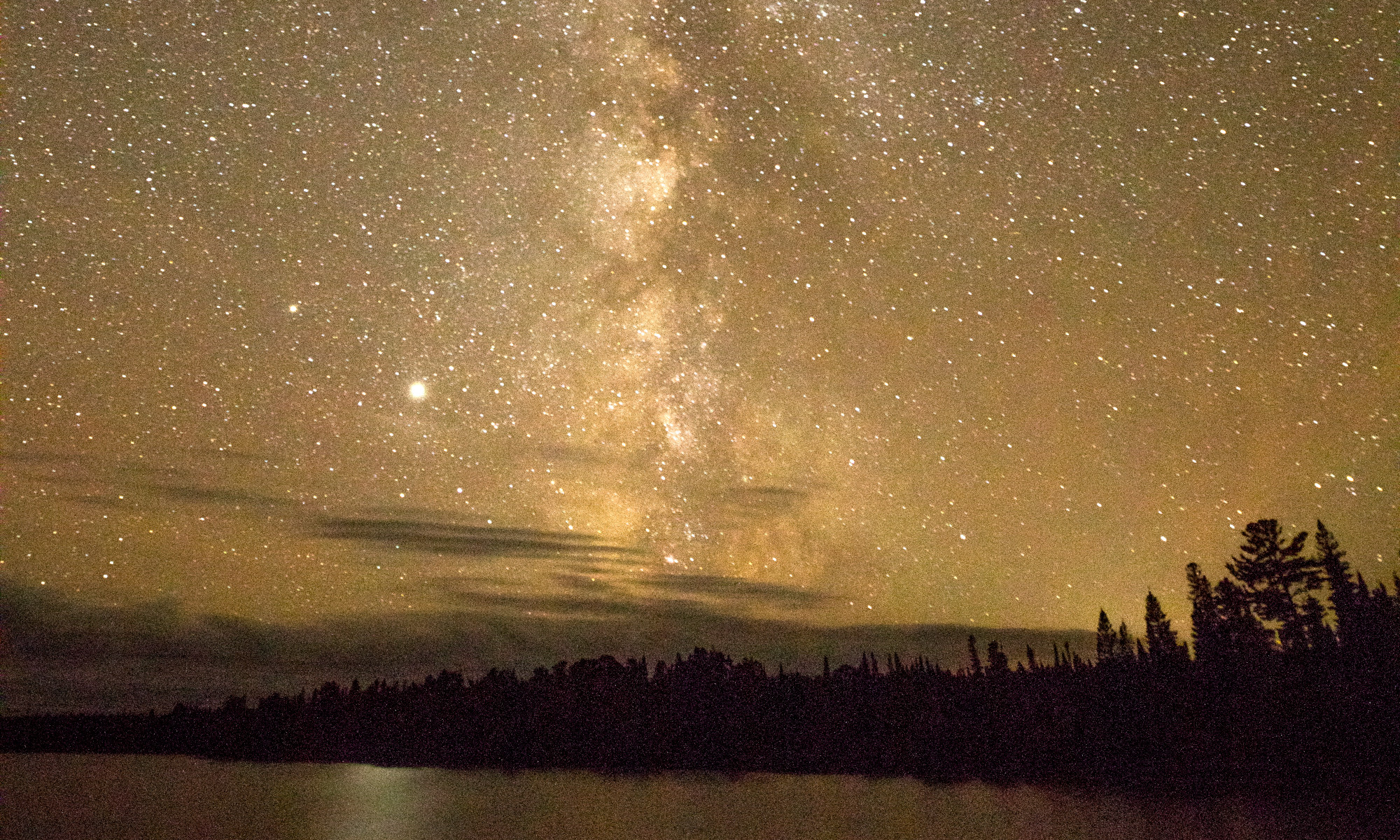
This week alone we have watched bald eagles fly around and over the property — the wingspan on them is something else up close — along with hawks and falcons, and a couple of merlins that have decided to stick around a while longer. None of that is a coincidence. Late September is peak season for exactly this, and it is worth understanding why the Keweenaw sees this kind of traffic, and what it has to do with keeping our lights in check.
Birders call the Keweenaw “the crossing place.” The peninsula sits on the Mississippi Flyway, and because it juts so far out into Lake Superior, it funnels migrating birds the same way a shoreline does anywhere on the Great Lakes: research using weather radar has found that birds actively avoid long crossings over open water, concentrating instead along shorelines at densities up to four times the surrounding area. A narrow peninsula like ours is exactly the geography that creates that kind of bottleneck, for raptors moving by day and songbirds moving by night alike.
The Keweenaw Mountain Lodge’s own birding notes point out that autumn conditions typically arrive mid-to-late September, and that Brockway Mountain’s summit is actually easier to reach for fall migration watching than for spring, since spring visits often fight snow cover. Most of the regional hawk-watch spotlight goes to Hawk Ridge in Duluth, at the far western end of Lake Superior, which is a legitimate fall raptor destination in its own right. But Brockway, at our end of the lake, is very much a live fall story too — not just a spring one — and this week’s eagles, hawks, and lingering merlins are the proof of it. Merlins in particular are small, fast falcons that often follow the same migration corridors as the songbirds they hunt, so seeing them stick around the property is a good sign that smaller birds are moving through nearby as well.
That daytime raptor show is only part of the picture. Roughly 80 percent of migratory birds travel at night, navigating by a mix of celestial cues and Earth’s magnetic field, largely invisible to us unless we know to look for it. BirdCast, the Cornell Lab of Ornithology’s radar-based migration forecasting tool, put the western Upper Peninsula at its highest nightly traffic alert level in late August of this year, with several million birds passing over Michigan in a single night. That nighttime migration is exactly where artificial light becomes a real hazard rather than a backdrop detail.
Jared Wolfe, an assistant professor of wildlife biology at Michigan Technological University, studies this directly — and he is not a stranger to this stage. Wolfe spoke at our own 2025 Upper Peninsula Dark Sky Festival, in a talk titled “Navigating the Impact of Light Pollution on Migratory Songbirds and Pathways to Solutions.” Wolfe, who co-founded the Louisiana Bird Observatory and the Biodiversity Initiative and has done fieldwork across the Americas and Africa, walked through how birds navigate by starlight and Earth’s magnetic field, and how artificial light disrupts both. A 2023 study in Nature Communications that Wolfe presented found that skyglow — the diffuse brightening of the night sky over developed areas — was a strong, positive predictor of where migrating birds stop to rest and refuel, in more than 70 percent of the models tested across the continental United States. That points to brightly lit areas functioning as “ecological traps,” pulling birds toward danger rather than safety. One of Wolfe’s maps zoomed in on exactly this stretch of the Upper Peninsula, around Marquette, showing how our own local light footprint shows up in that same national dataset.
At the building level, the mechanism gets very concrete. Wolfe cited a 21-year study of a single large Chicago convention center that found halving the building’s lit window area cut bird collisions roughly 11-fold in spring and 6-fold in fall, and that reducing lighting to the site’s historic minimum could cut mortality there by roughly 60 percent. On one particularly bad night, researchers collected close to 1,000 dead birds from that building alone. Wolfe is now developing acoustic deterrents meant to steer birds away from high-light, high-collision zones before they get close enough to be at risk. As he put it in an earlier talk at the Great Lakes Aurora Dark Sky Jamboree, unlike habitat loss, light pollution is a problem you can fix by “switching them off” and letting darkness do the rest — a message backed by decades of population data showing North American bird numbers down 29 percent, nearly 3 billion birds, since 1970. Michigan’s Upper Peninsula, with more than 450 recorded bird species, is a meaningful piece of that migratory map.
One more Lake Superior detail worth knowing: researchers along the lake’s North Shore have documented over 170,000 warblers migrating by day rather than by night, specifically because Lake Superior is so large, cold, and refuge-poor that a night crossing is unusually dangerous for a small songbird. Instead, they follow the shoreline visually, in far greater numbers when facing westerly winds — a very Lake-Superior-specific piece of migration science, and one more reason this particular stretch of shoreline matters.
So what should the community actually do with its lights right now? Nothing complicated, and nothing that costs money:
- Turn off nonessential outdoor lighting overnight through the next several weeks of peak migration, especially decorative, architectural, or landscape lighting that is not doing safety work.
- If a light needs to stay on for safety, shield and aim it downward rather than letting it spill sideways or upward into the sky.
- Use motion-sensor or timed lighting instead of dusk-to-dawn fixtures left on by default.
- Draw curtains or blinds at night if you have bright interior lighting near large windows, particularly upper floors that migrating birds may fly closer to.
- Favor warm-colored bulbs over bright white or blue-white light where you have a choice, since birds are especially drawn to and disoriented by blue-rich light.
We wrote recently about a very different, much stranger lighting debate playing out in orbit, over whether a company should be allowed to beam sunlight down from space. This one is the opposite kind of problem: it is entirely on the ground, entirely within our control, and entirely solvable tonight with a switch. That is worth doing something about.
- What is happening right now: peak fall migration over the Keweenaw, with eagles, hawks, and merlins visible on the property and heavy nocturnal songbird traffic reported by BirdCast for the western U.P.
- Why the Keweenaw specifically: the peninsula sits on the Mississippi Flyway and funnels migrating birds along Lake Superior’s shoreline, both by day (raptors) and by night (songbirds)
- The research: Michigan Tech’s Jared Wolfe studies how artificial light disrupts birds’ celestial and magnetic navigation, contributing to over a billion building-collision deaths a year nationally
- What to do about it: turn off nonessential outdoor lighting overnight through the next several weeks, shield what must stay on, and favor warm, downward-aimed light